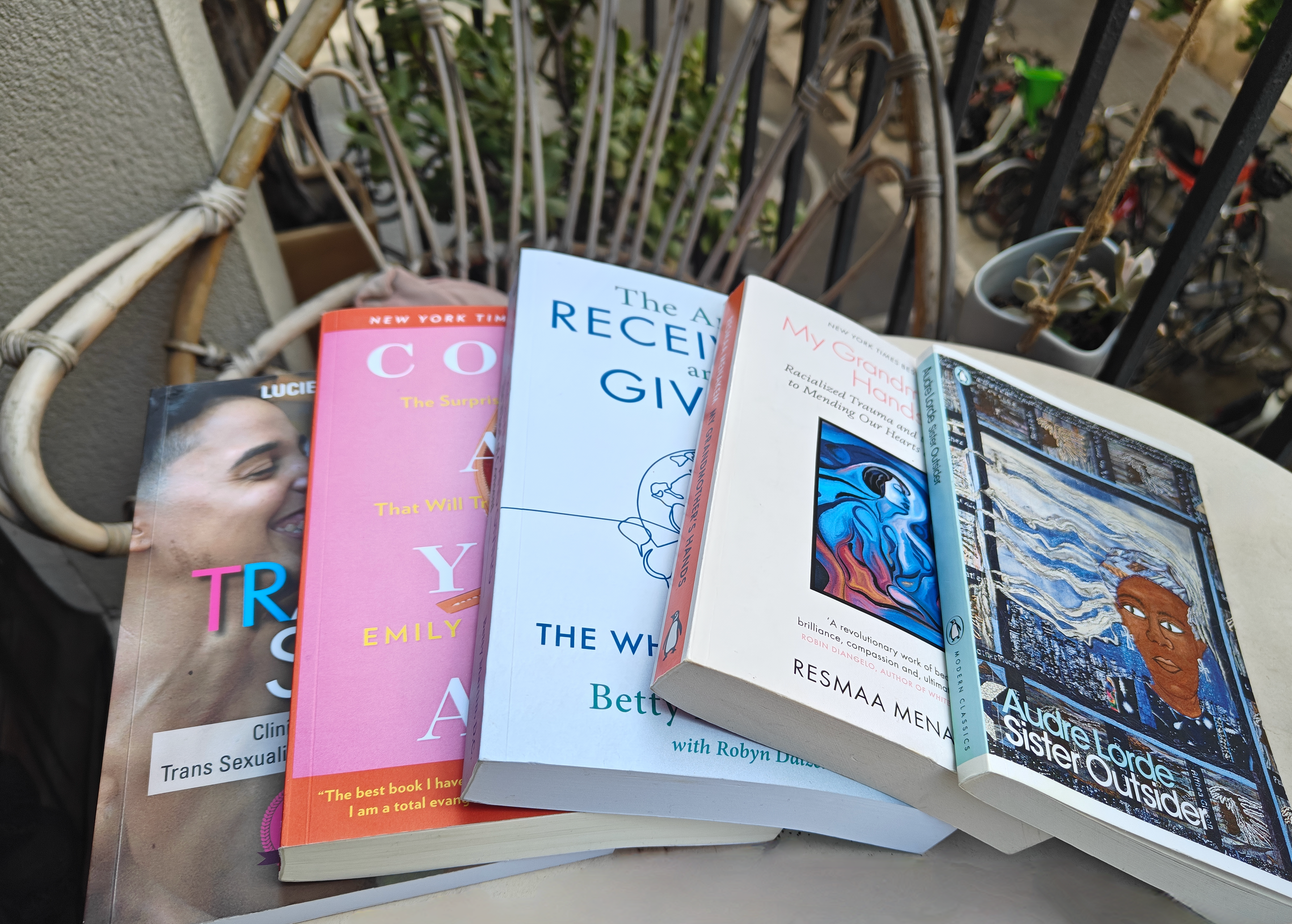
I was asked recently for a reading list after one of my workshops. We were working on erotic embodiment and internal (felt) consent among other things. So I decided to pull together a list of my favourites. I’ll keep updating this list to expand the topic areas and books in coming weeks.
Check them out!
Eroticism, Sex, Sexuality, Gender & Consent
Meg-John Barker & Alex Iantaffi – Life Isn’t Binary
This celebration of gender diversity dismantles rigid norms, flips binaries on their head, and offers a spectrum invitation: you don’t have to pick one side—or any side—to be real. Warm, practical, and deeply affirming, it weaves personal stories, social science, and accessible tools to help readers craft gender identities and expressions that actually fit.
This one hits me deeply as I feel like we have expanded the number of boxes, but still expect everyone to choose. I rather feel like a river, fluid and adapting.
Audre Lorde – Sister Outsider
Lorde’s collection of essays and speeches pulses with fierce clarity, Black feminist wisdom, and revolutionary fire. Central to the collection is her legendary essay “Uses of the Erotic,” where she reclaims the erotic not as trivial or pornographic, but as a deep well of power, aliveness, and self-connection. She invites us to feel more, know more, and refuse less—recognising the erotic as a wellspring of resistance and embodied truth. Sister Outsider remains a vital companion for those seeking to live, love, and liberate through intimacy and inner authority.
Eroticism as power, self knowing, and drive are core elements of how I work and Lorde’s essay has been a huge inspiration.
Adrienne Maree Brown – Pleasure Activism
Brown redefines activism through a lens of radical pleasure—arguing that collective liberation depends on joyful living. Interweaving essays, poetry, and practical tools, she offers an invitation to embrace pleasure as medicine, resistance as delight, and healing as revolutionary. A soul‑stirring manifesto for the pleasure‑producing revolution.
Like Audre’s essay, this is foundational to what I teach. If we seek to be our full selves, to actually go after what we want, to even know what that is, we have to allow ourselves to tap into our own pleasure and desire.
Betty Martin – The Art of Giving and Receiving
A classic in the realm of consent and communication, Martin brings clarity and tenderness to giving and receiving needs and desires. Her “wheel of consent” offers a framework for co‑creating intimacy that honors choice, consent, and mutual fulfillment—inviting us to practice presence, generosity, and honest boundary‑setting in all relationships.
This one is honestly better as a workshop, as the book feels a bit repetitive and it’s hard to feel what she’s talking about. I highly recommend doing a workshop on this method, especially one that focuses on embodiment to ensure you’re learning to feel your body’s clues to consent.
Dr. Laurie Mintz – Becoming Cliterate
Mintz shines light on one of the most persistent, yet solvable blind spots in our culture: women’s orgasm equality. Blending research, real stories, and how‑to advice, this guide empowers women and their partners to rethink arousal, smash orgasm myths, and confidently claim pleasure as a right—a celebration of embodied, joyful sex.
Yes, girl.
Jack Morin – The Erotic Mind
Morin invites us on a gentle journey into the heart of our sexual imaginations, exploring the “erotic loop” of desire, fantasy, and arousal. With warmth and insight, he offers both a map and a mirror—helping us recognize what truly sparks us, understand personal erotic schemas, and expand our erotic possibilities in deeply honoring, authentic ways.
I especially appreciate the discussion here about where our eroticism comes from and how we keep desire alive.
Emily Nagoski – Come As You Are
If you only read one book from this list, let it be this one. Nagoski speaks directly to our nervous systems, giving permission to meet our sexuality where we really are—through “responsive” and “spontaneous” arousal, contextual wiring, and the power of self‑compassion. Playful, science‑driven, and radically affirming, it offers tools and truths to dismantle shame and nurture real, pleasure‑centered sex lives.
This one busts so many cultural myths about sex, it’s a must read.
Emily Nagoski & Amelia Nagoski- Come Together
In this thoughtful and reassuring follow-up to Come As You Are, the Nagoski sisters explore how couples can maintain strong, fulfilling sexual connections over time. Blending neuroscience, emotional literacy, and personal storytelling, Come Together offers tools for deepening intimacy, navigating mismatched libidos, and staying connected in the ebb and flow of long-term relationships.
Though mostly focused on monogamous relationships, this is great for nurturing your erotic bond with curiosity, care, and a sense of play in any relationship style.
Esther Perel – Mating in Captivity
Perel examines the apparent paradox of long‑term love and sustained erotic desire. Tender yet incisive, she explores how intimacy can quash desire, and why cultivating mystery, autonomy, and adventure can reignite erotic tension. It’s a provocative invitation to re‑imagine erotic life within committed relationships.
Especially good for the monogamous folks, this still has great lessons for those of us in open long-term relationships, too.
Nadia Bolz-Weber – Shameless: A Case for Not Feeling Bad About Feeling Good (About Sex)
Bold, confessional, and unapologetic, Bolz-Weber reframes Christianity’s relationship with sex—moving from shame to radical grace and bodily celebration. With biting wit and deep vulnerability, she challenges religious and cultural taboos, dismantles shame’s power, and calls for a gospel of sexual wholeness grounded in dignity, healing, and joy.
As someone who grew up with purity culture and anti-sex messaging, this one really hits home. It’s sometimes difficult to even understand the impact that patterning had on me, and this helped immensely.
Melissa Walker – Whole Body Sex
Walker presents a holistic, inclusive guide to sex that centers bodily attunement, nervous-system awareness, and pleasure for all genders. Full of realistic practices, trauma-informed tips, and normalization of our messier, more tender sexual selves, it’s a deeply nurturing resource for anyone seeking body-aware, life-enriching sexuality.
This one is great for really embracing desire beyond just penetration, though it’s aimed at sex therapists.
Kasiah Urbaniak – Unbound: A Woman’s Guide to Power
Drawing from her unconventional roots as both a dominatrix and a Taoist nun, Urbaniak invites women into a fierce reclamation of agency and voice. She frames power not as domination, but as the ability to direct attention—knowing when to hold it inward or wield it outward. Through vivid tools like “shifting the focus,” the “Jason” technique, and emotional alchemy, she guides readers to smash the “Good Girl” conditioning, decode hidden power dynamics, own their desires, and ask—truly ask—for what they need (and deserve). Unbound is part manifesto, part tactical field guide—a bold call to live unapologetically from your most alive self.
This one has also shaped a lot of my work, helping to understand how to step into power and wield it from an embodied, connected place.
Zachary Zane – Boyslut
Boyslut is both memoir and manifesto: a queer coming‑of‑age story steeped in sex positivity, healings, and radical self‑loving. Zane traces his journey through sexual exploration, heartbreak, and community, weaving in research and cultural critique. It’s an invitation to reclaim queer desire, intimacy, and pleasure as sources of liberation and resilience.
Kink
Jesse Bering – Perv: The Sexual Deviant in All of Us
Bering takes us on an electrifying journey into the psychology and biology of why we’re wired the way we are—examining taboos like paraphilia, kink, and unconventional desire with curiosity and compassion. He reframes “perversion” as a window into the mind, asking us to laugh, learn, and reconsider what counts as “normal” in sexuality.
This one is great if you feel any shame or reluctance to dive into the darker corners of your desire.
Natasha NawaTaNeko, Somatics for Rope Bottoms
This insightful guide offers 12 somatic inquiries designed to deepen a rope bottom’s awareness of their body, emotions, and boundaries. Blending kinbaku practice with principles of somatic therapy and sexological bodywork, Natasha invites readers to explore the “why” behind being tied—focusing on agency, sensation, consent, and emotional safety. Ideal for both newcomers and experienced bottoms, this book emphasizes self-inquiry over technique, making it a valuable read for anyone engaging in conscious, embodied rope play.
If you want to take your rope practice to the next level, this is highly recommended.
Leigh Cowart – Hurts So Good: The Science and Culture of Pain on Purpose
A provocative exploration of why pain can also feel euphoric, Hurts So Good blends science, sociology, and first-hand kink narratives. It untangles physiological pathways like endorphins and oxytocin and cultures across BDSM scenes. The result: a smart, boundary- honouring guide to pleasure’s more intense edges.
LOVE this book. So fun and a great explanation of how pain can turn us on.
Embodiment, Polyvagal Theory & Trauma
Resmaa Menakem – My Grandmother’s Hands
Menakem centers Black and white bodies in a transformative dialogue about racialized trauma as a somatic legacy. He guides us through ancestral wounds stored in our nervous systems, naming the pervasive effects of collective violence, and offering therapeutic rituals and dialogue practices to foster embodied racial healing and somatic reconciliation.
Intergenerational trauma has such an impact on our lives, and while indigenous knowledge has known this forever, western science is finally catching up. This book is part ancestral exploration, part science, and a lot of somatic practices to help you heal.
Gabor Maté – The Myth of Normal & When the Body Says No
Maté links chronic disease, trauma, and societal norms in two intertwined works. The Myth of Normal challenges us to reconceptualize well-being in a world that pathologizes difference. When the Body Says No explores how repressed stress and emotional shut-down lead to illness. His holistic vision invites us to heal through connection, authenticity, and compassionate presence.
If you are dealing with any chronic health problems or want to understand the impact of societal trauma on our lives, these are must reads.
Stephen Porges & Seth Porges – Our Polyvagal World: How Safety and Trauma Change Us
With clarity and resonance, this book brings Dr. Stephen Porges’s polyvagal theory to everyday life—explaining how our nervous systems shape connection, stress, and safety. Co-written with his son Seth, it’s deeply relational, illuminating how we co-regulate, heal, and struggle, offering real-world tools to ground, attune, and rewire toward sanctuary.
We don’t heal alone. We heal in connection, in community, and must recognize the impact of the systems around us.
Sonya Renee Taylor – The Body Is Not an Apology
Taylor’s powerful call for radical self-love reframes body liberation beyond mere fat-acceptance or size politics—it’s an all-inclusive, anti-oppression mandate. She writes with poetic fire, challenging internalized shame and systems of exclusion, and gives us wholehearted, accessible practices to return home to our bodies with compassion and pride.
If you’ve ever struggled with body image (who hasn’t?!), this one is for you.
Bessel van der Kolk – The Body Keeps the Score
This seminal work illumines trauma’s imprint on the body and mind—with neuroscience, case studies, and treatment pathways. Van der Kolk gives voice to lived suffering, shows how trauma gets lodged in physiology, and offers innovative healing tools ranging from EMDR to yoga and neurofeedback—an invitation to reclaim embodiment and resilience.
This is one of the first books I ever read when first getting into therapy as a personal practice. It is NOT an easy read. I don’t recommend reading it if you have trauma and haven’t worked on it yet with a therapist. That said, it’s a powerful read that ultimately helped upend my life (in a good way).
Neurodiversity
Robert Chapman – Empire of Normality: Neurodiversity and Capitalism
Chapman critically examines how capitalist systems enforce neurotypical norms, marginalizing neurodivergent experience. With rigor and nuance, he shows how diagnoses are often shaped by profit motives, how productivity culture pathologizes difference, and why we need systemic shifts toward valuing human neuro-variation as political and ethical imperative.
Fck this late-stage capitalistic system.
C.J. DeBarra – Neuroqueer: A Neurodivergent Guide to Love, Sex, and Everything in Between
Neuroqueer is an accomplished blend of memoir, research, and affirming guidance for neurodivergent people exploring intimacy. DeBarra tenderly charts the intersections of queerness, neurodiversity, trauma, and consent—offering strategies to navigate relationships, sexuality, and self-care with clarity, consent-practice, and embodied celebration.
This is the book I wish I wrote and CJ is an incredible human. Highly recommend for anyone struggling with how neurodivergence impacts your relationships.
Non-Monogamy
Dossie Easton & Janet W. Hardy- The Ethical Slut
A foundational text in the world of consensual non-monogamy, The Ethical Slut reclaims the word “slut” and redefines it as someone who celebrates sexuality with honesty, consent, and joy. The book covers a wide range of relationship styles and offers practical guidance on communication, jealousy, boundaries, and self-discovery.
While there are some parts I find overly heteronormative and a bit dated, I recommend it for anyone curious about what it can look like to embrace sexual and emotional openness with integrity.
Jessica Fern- Polysecure
Bringing together the worlds of attachment theory and consensual non-monogamy, Polysecure explores how we can cultivate secure, resilient relationships — whether we have one partner or many. With deep compassion and a grounding in psychological insight, Fern helps readers examine their own attachment patterns and build secure connections in complex relational systems.
This was one of the first books I read about polyamory and it the deep work on attachment styles was hugely influential to my overall personal growth. I highly recommend it if you keep finding yourself in the same kind of unsatisfying partnership(s).
Jessica Fern & David Cooley- Polywise
A companion to Polysecure, Polywise moves from theory into lived practice, offering thoughtful questions, real-life scenarios, and co-authored reflections from Fern and Cooley’s relationship. It’s a grounded, practical guide to navigating everyday polyamorous life with clarity and compassion.
I think of this book as a level 2 for ENM. It’s great if you’re already living non-monogamous relationships and are ready for support it in real time.
Tristan Taormino- Opening Up
This comprehensive guide dives into the many forms that open relationships can take — from polyamory to swinging to solo poly — with voices from a wide range of lived experiences. Taormino covers practical issues like time management and sexual health alongside emotional challenges like jealousy and trust. It’s a valuable resource for anyone exploring non-monogamy, especially if you’re just starting out, or circling back to more of the theory.
Dedeker Winston, Jase Lindgren, and Emily Matlack- Multiamory: Essential Tools for Modern Relationships
Written by the hosts of the Multiamory podcast, this book is packed with communication tools, mindset shifts, and relationship practices that support all kinds of modern love — monogamous, polyamorous, or somewhere in between. It’s refreshingly practical and focuses on actionable strategies like “repair conversations” and “triforce communication.” I recommend it if you’re looking to level up your relationship skills in a way that’s both grounded and expansive.
* As an Amazon Associate, we earn from qualifying purchases.
Leave a Reply